
What if an art studio were an invitation to explore what it means to be human?
I had been studying trauma and the ways creative practice can help people settle, process experience, and reconnect with themselves and others. I began wondering whether an art studio might be one way our church could care for the wider community.
I asked my pastor if we could offer our neighborhood a gift with “no strings attached”—no fees, no proselytizing, no expectation that anyone attend the church. Just a place where people could come, make, process, and belong.
He was willing to give it a try, with two limitations: there was no budget for it and we needed to return the room in good condition when the church needed it again.
Near an outside entrance was a former office that had gradually become a junk room.
I asked for the room.
MAKING SOMETHING FROM WHAT WE HAD
We began with what we had.
My husband covered the existing carpet with a plastic tarp and built a plywood floor over it so people could make freely without damaging the room. I brought my art supplies from home and filled the walk-in closet.
Then other people began bringing things.
Supplies appeared. People offered materials. I visited local art stores and told them what we were trying to create. One store told me that if I could assure them the Studio would remain free and that there would be no proselytizing, they would give us $100 in art supplies every month, along with an ongoing discount.
Sometimes people simply wanted to give us money. We asked the church to establish a dedicated account—not part of its operating budget—where those gifts could be received and used for the Studio.
The Studio had no budget. But it was being provided for.
AN OPEN STUDIO
The Studio had regular open hours, publicized beyond the church—including in the local newspaper after a neighborhood correspondent came to interview us. It was created primarily for adults; minors were welcome when accompanied by a responsible adult.
People did not need to arrive knowing what they wanted to make. Each month I offered an optional project for anyone who needed somewhere to begin. Otherwise, we encouraged people to pay attention to what was stirring within them and choose the materials that might help them explore it.
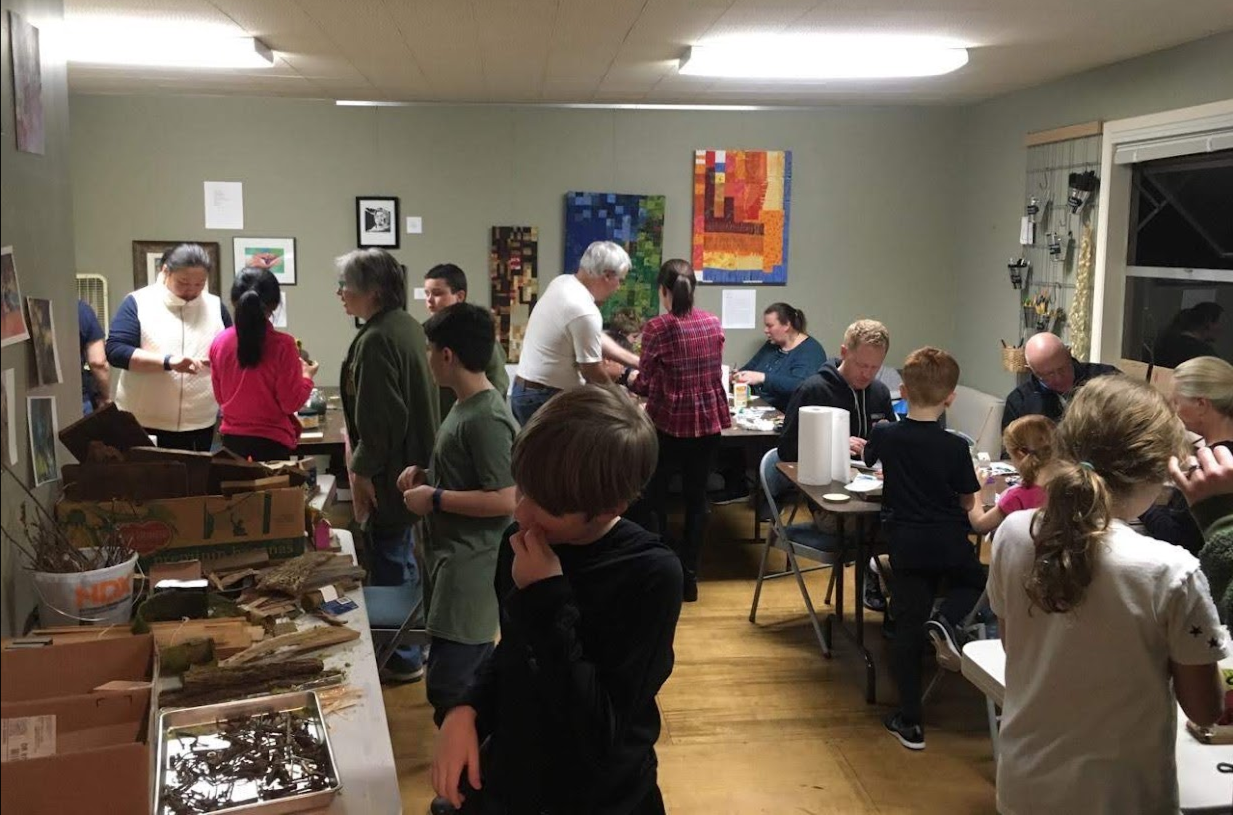
Once a month we held a Family Night with two projects to choose from. Families left with their family artwork and a handout called Questions for the Drive Home, an invitation to continue talking together about what they had experienced.
We offered classes for only two reasons: to teach people how to use materials available in the Studio, or to raise money to replenish supplies.
The purpose wasn't to teach people what to make. It was to create a place where they could discover what they wanted—or needed—to make.
MAKING ROOM TO PARTICIPATE
I began looking for unofficial mentors—people who had knowledge or experience they might be willing to share, without needing to become formal instructors. There were many—people who just wanted to work in the space but were willing to be interrupted.
The first money I spent was on everything we needed for screenprinting. A woman I knew had been a screenprinter twenty years earlier and wanted to see what she remembered, but she couldn't afford to buy the materials herself.
It was the best money I spent.
She rediscovered her love for the medium. Then teenagers began coming to the Studio over the summer and became entranced by what she was doing. She taught them what they wanted to know, and soon the Studio was filled with drying T-shirts and paper prints—motorcycles, flowers, words and sayings.
Knowledge moved through the room because someone had been given the materials to remember what she already knew.
Sometimes participation meant designing an experience in which it was difficult for anyone to be “better” than anyone else.
For our first Family Night, we bought large canvases and local hardware stores donated small cans of house paint that had been ordered but never picked up. Each family received one canvas. Each person chose a can of paint and a stick.
Together, they made their own Jackson Pollock-inspired painting—dripping and flinging paint onto a single shared canvas.
The project was intentionally designed so that artistic ability offered no particular advantage. A child and an accomplished artist could both make a mark. Everyone could contribute to the whole without having to worry about being incompetent.
The point wasn't to make everyone equally skilled. It was to make everyone's participation matter.
PROCESS, NOT PERFORMANCE
We wanted the Studio to be a safe place where people could listen to the micromovements of their own souls and be moved by one another. For that to happen, the space could not become competitive or exclusive.
The emphasis needed to remain on process rather than product.
That didn't mean the product didn't matter. People want to make something they are proud of, but becoming aware of what was happening within themselves while they made it mattered more.
This shaped how we chose and trained our volunteers. I deliberately sought spiritual caregivers rather than artists. One of our principles was never to comment on the artwork itself—not even to say, “That's beautiful” or “I love that.” We didn't want to discourage people, but more importantly, we didn't want to train them to make for our approval.
Instead, we invited them to tell us about their work. What were they noticing? Where had they become frustrated? What had surprised them? What had worked? What did they want to try next?
When someone was unhappy with something they had made, we asked them to be specific. What, exactly, wasn't working for them? What might they change? What could they experiment with? The hope was to help people develop a vocabulary of analysis, experimentation, and creativity rather than slipping into self-condemnation.
We wanted people to notice their own agency and their own trustworthiness.
WHAT HAPPENED IN THE ROOM
Over the three years the Studio was open, more than 5,000 people came through its doors.
An affluent woman painted beside a woman experiencing homelessness. They became engrossed in a conversation about something they had in common: the fear of facing a blank page.
A middle-aged man used collage to process the death of his daughter. One day he told us, “This place is church to me.”
A woman who lived with schizophrenia had often felt out of place. She loved the voice-fullness of mixed media and discovered people who were genuinely interested in the ways she perceived the world.
A young atheist formed a strong friendship with an older conservative evangelical. They talked about everything. Everything.
A senior citizen with intellectual disabilities developed a body of work, exhibited it, and sold originals, prints, and cards.
A woman with dementia came with friends who wanted to spend time with her but weren't sure what they could still do together. They thought perhaps they could color.
Refugees waiting for work permits and housing came to make art when they did not yet have enough English to tell their stories in words.
Couples came for date nights.
People attending addiction-recovery programs at the church found their way into the Studio.
We offered groups for people processing traumatic grief and loss, along with photography and poetry groups…
The art gave people something to do with their hands while other things became possible.
The Studio remained open for three years and welcomed more than 5,000 visits before the COVID-19 pandemic brought our time together to an unexpected end.
Looking back, what I learned is simple:
Our souls are shy.
When we offer spaces of creativity and being, without placing expectations on anyone, our souls come out to play.
And we are all better for it.