
What began as a project about community became an experience of community.
Abraham's Stars began with a request: create something that would accompany a summer sermon series on Abraham, invite children and adults to participate together, and explore what it means to be a community.
I suggested a community weaving project. Anyone can weave.
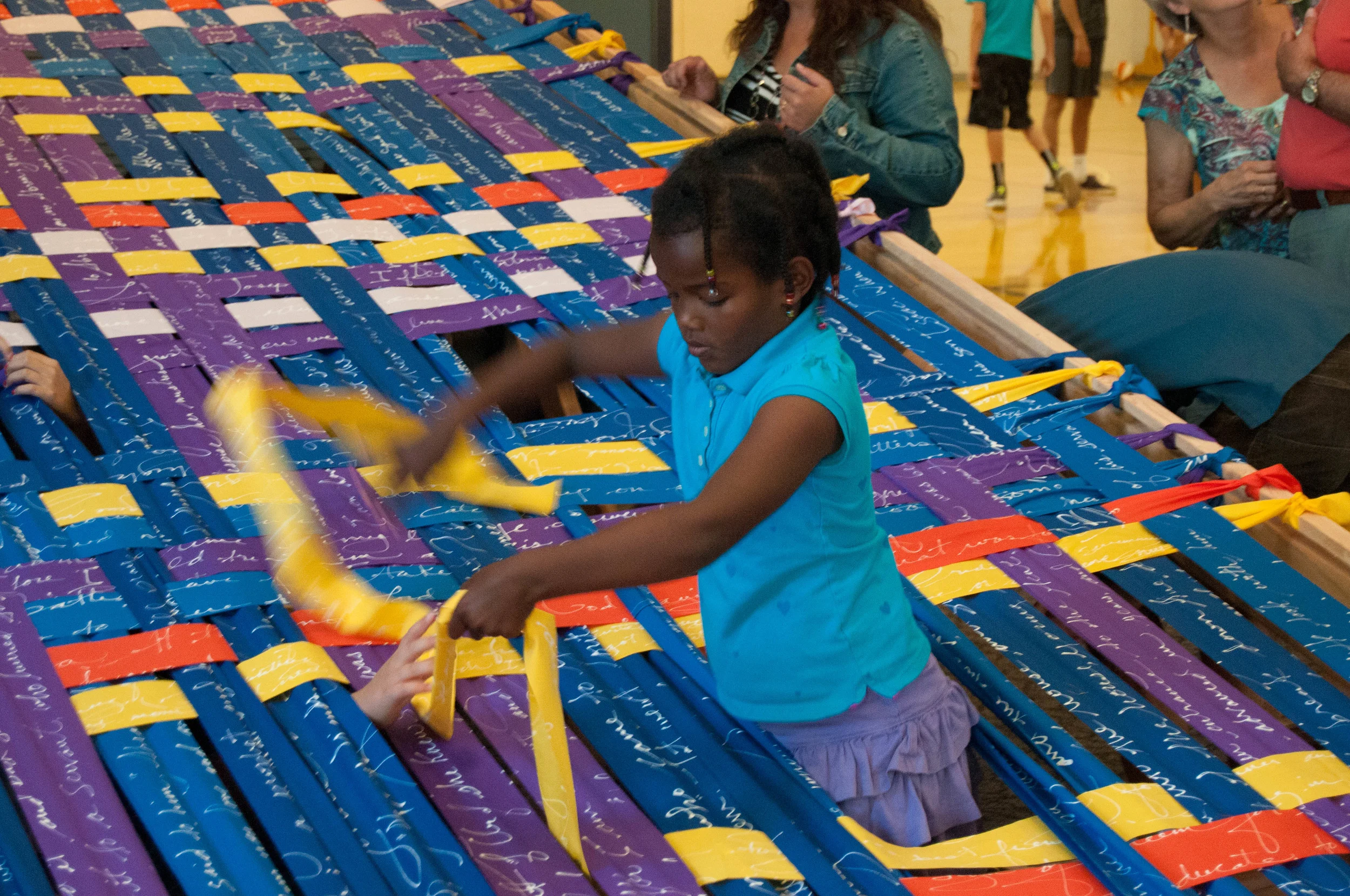
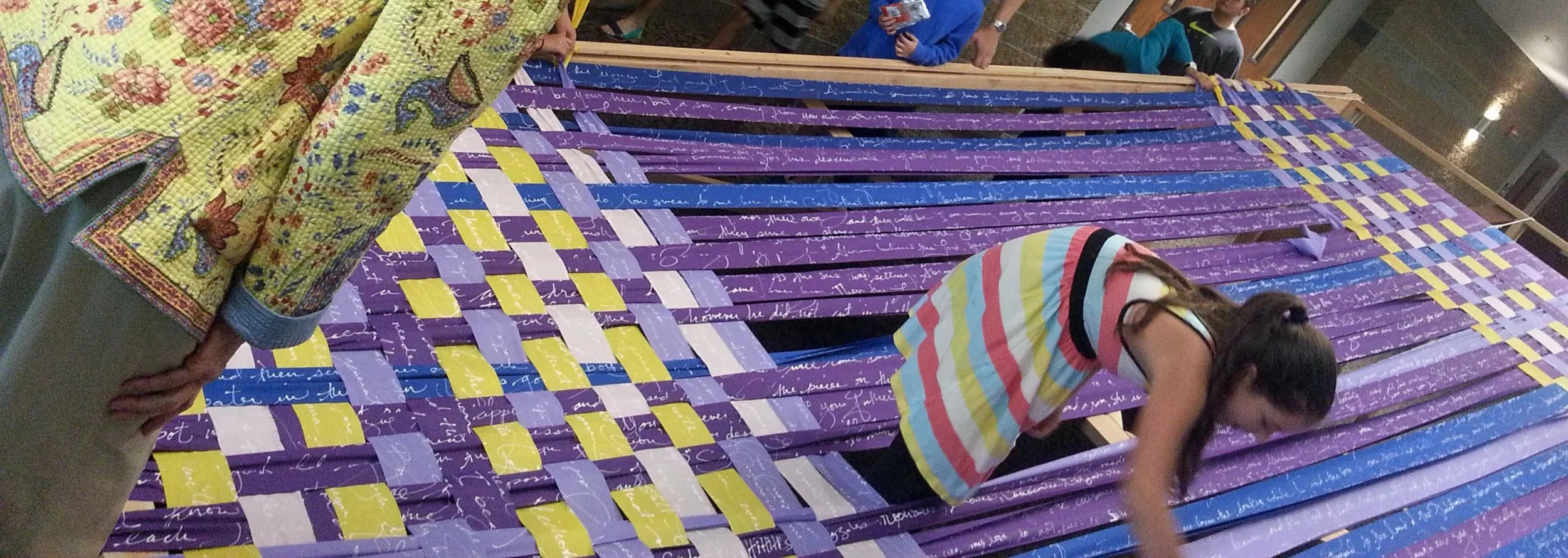
Three room-sized looms held Abraham’s story as the warp and hundreds of congregants’ stories as the weft. People wove, painted, stitched, told stories, lingered, helped one another, and found unexpected ways to belong.
The work could not be completed alone—and that was intentional.
Over the weeks that followed, hundreds of people found themselves caught up in one another's stories.
STORIES BECAME THE WEAVING
Abraham's story came first. I mixed paint with fabric medium and wrote the Genesis account by hand across 1,512 feet of fabric. Those strips became the warp—the structure through which everything else would be woven.
Then we asked people for their stories.
For two weeks, members of the congregation responded to questions about revelation, weakness and strength, belonging, strange callings, gain and loss. We received 244 stories: stories of healing and suffering, love and loss, certainty and questioning, holding on and letting go.
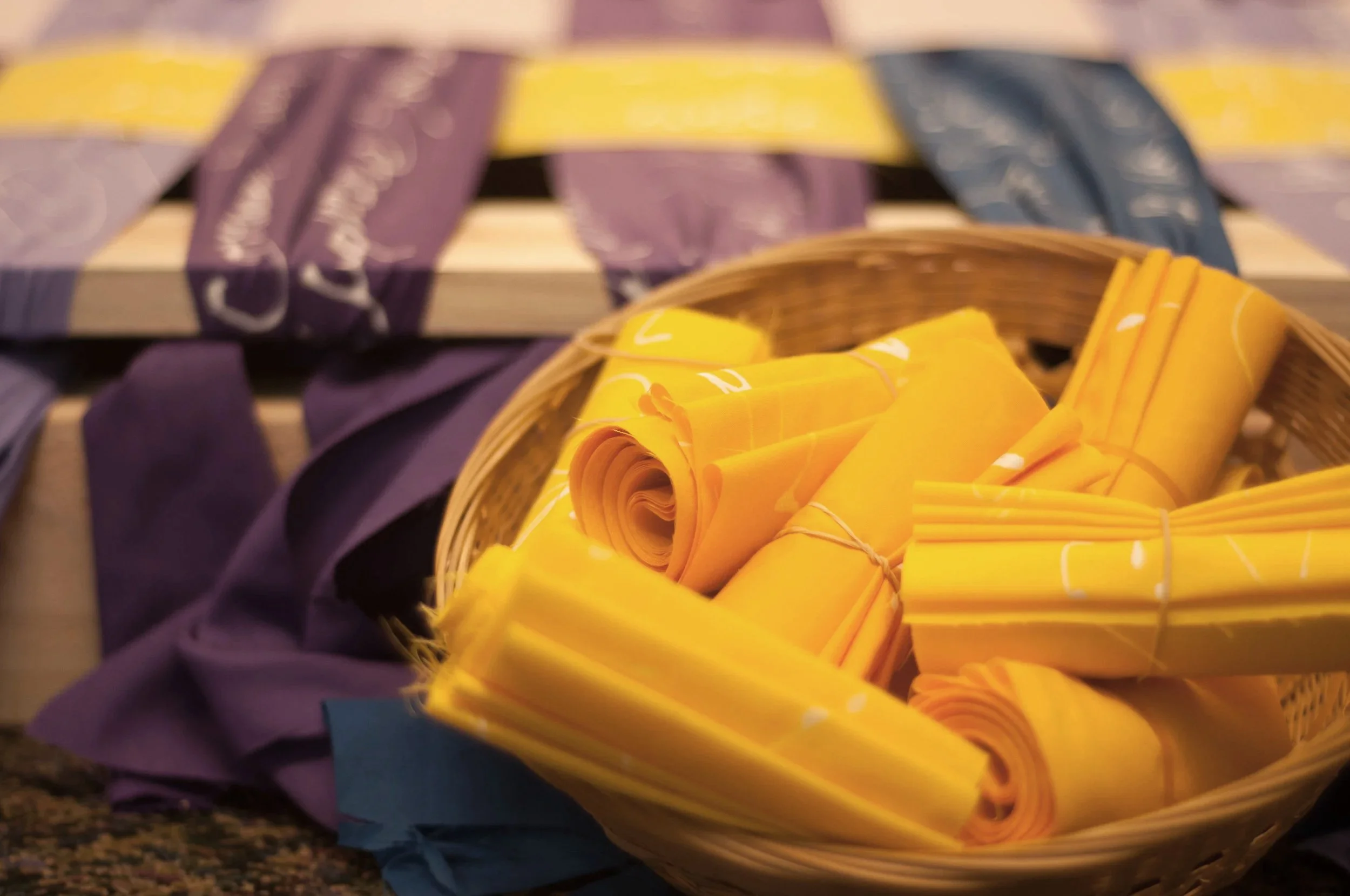
I wrote those stories onto the colored fabric that would become the weft, loosely placing them alongside moments in Abraham's story that seemed to echo them. Then we cut them apart.
Once people began weaving, the stories crossed and touched in ways no one could plan.
One person wrote about fearing that generational wounds might harm her “seedling.” By chance, her strip was woven beside the word “tree” in Abraham's story—the place where three visitors sit beneath a tree and promise that Abraham's descendants will be blessed.
Sometimes our stories converge
One of the submitted stories stayed with me. I recognized the feelings of loss and disappointment, even though I hadn't lived the same experience.
Later, while I was working beside another woman, she began telling me her story. I recognized it.
“I was so touched by your story when I read it,” I told her.
She looked at me. “Michelle, I never turned in a story. I didn't know how to write it. How do I say that sometimes I am mad at God?”
She hadn't written the story I had read. Someone else had experienced something close enough to her own life that, when she heard it, she recognized herself.
Her story was already in the tapestry.
we played together
There was so much joy around the looms. People walked around them, reached across them, climbed underneath and inside them. They lingered and laughed.
We gave and received permission to play. To just play.
We played.
Together.
Instructions to the volunteer helpers were:
Here are the general guiding principles:
What we are doing is offering hospitality.
The default word is, "Yes!"
We want to include everyone. Please encourage cooperation. Shorter persons can weave the lower end and from underneath, those with mobility issues can weave from the side, etc. The looms are large so it will be very difficult for someone to weave the entire length alone. That is intentional. We are all a part of one another's stories.
Have FUN! Lots of it!
There were four older men who had not turned in stories, and made it clear that they did not want to weave. However, they were fascinated by the loom construction and had lots of questions about the fabric preparation. I answered all the questions to the best of my ability and then became involved in something else. Later, I noticed that they had deputized themselves as unofficial docents and hosts. All four of them had little groups in tow and were giving tours filled with loom construction and fabric preparation trivia. I heard them call this "our project," "our looms," "our tapestries," and it made me so happy.
We all participate in our own ways.
we showed up
In order to stabilize weaving enough to remove it from the loom and then hang it, we had to sew every warp piece to the one next to it—by hand.
There was no other way, no short cut.
We had to show up and put in the work. We worked side by side and had to put the time into building relationships.
We were here every day for 7-9 hours a day (except Sundays) for 4 weeks. 67 different people showed up to volunteer. Many came numerous times.

This is the part that scared me. Most of my work I do alone. Community pinches me. At this point the tapestries held my fears:
that I don’t belong and will never be able to break in
that I will fail.
But early in this process someone came, and she sewed quietly. I worried about how to entertain her; what should I say? After several hours, she thanked me for providing a space where she could sit with women and just be, where she didn’t have to talk.
And just like that, the Lord released me.
Instead, I prayed every morning that Godself would offer hospitality, that the lobby would be a safe place and that everyone would feel welcome here. And every single day God brought people who needed one another to sew next to each other.
Someone whose granddaughter has gone through a series of inconclusive medical tests told her story beside someone whose child had been through the same thing. We shared lives, good books, good movies, recipes. Several women blessed my 16 yo daughter, and then she enjoyed spending time with an 11 yo sewer. At one point someone brought a friend who was visiting. This friend was an occupational therapist who works with elderly dementia patients, and she lived 1 mile from my mother in Virginia who has early onset dementia. God changed the way I see belonging.
While I stitched in the lobby, a man came by. “You’re listening to stories? I have a story.”
“It’s too late to write it into the tapestry,” I told him, “but if I can keep working while you tell me I will stitch it into this piece.” A total of 73 people over 4 weeks stopped by just to tell their stories. Their stories are just as much a part of this work as the ones written.
The lobby became a sacred space. One woman walking through said, “There is a stillness here, a peace. I can hear the women talking, so it isn’t quiet that I am feeling. No, it’s stillness.”
what we made
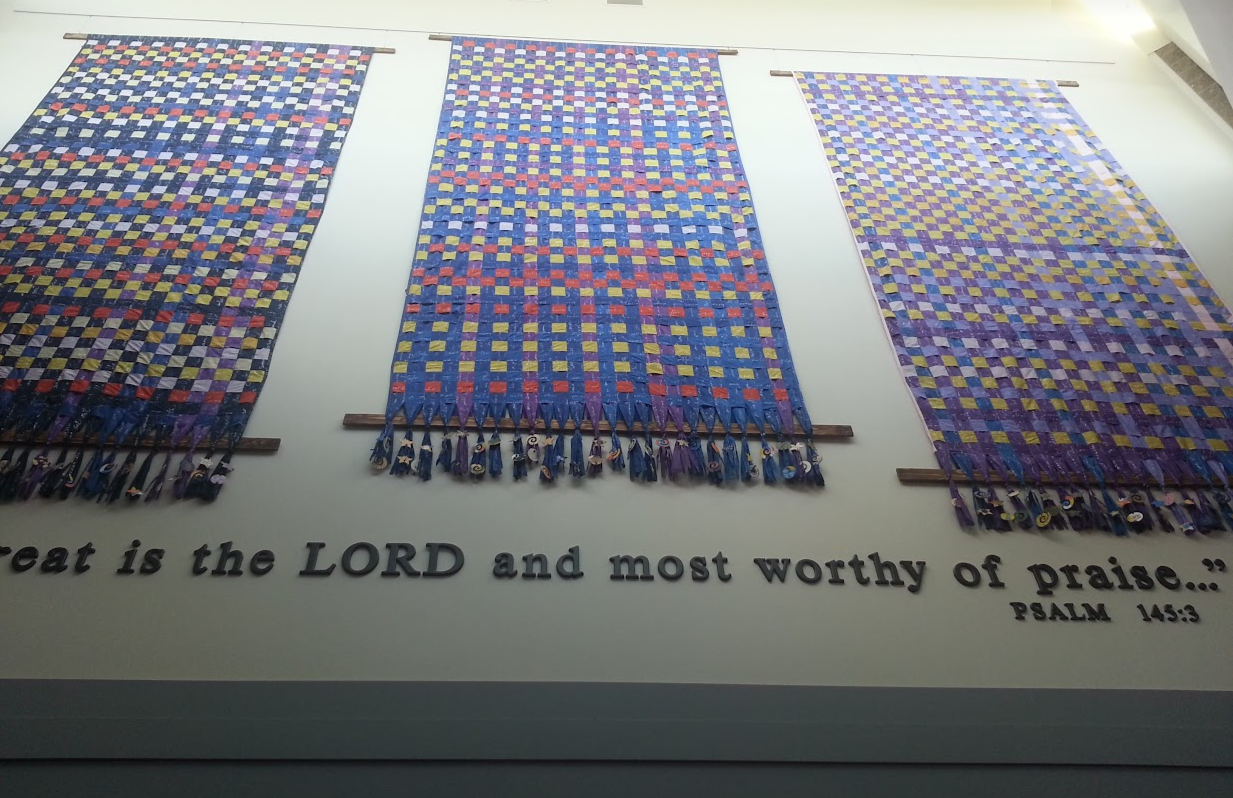
This started as an offering to the Lord, and a project to illustrate community. It became a love letter to my church.
To all those people who said, “I would never put so much work into something,” as they walked through on their way to put just as much work into preparing for their own ministry: I see you.
To those people whose stories filled my heart: I see you.
But in the end, I was the one most changed.
By your courage as you faced every day. By your faith as you held onto hope. By your love for your neighbors and your families. And by the people who came and sewed beside me, offering their friendship.
What began as a project about community became an experience of community.